


Lead Generation vs Demand Generation
Before we dive into tactics, we need a clear picture of the two disciplines. This is where most startups go wrong—they use the terms interchangeably, which leads to misallocated budgets and frustrated teams. Let’s fix that.
What Is Demand Generation?
Demand generation is the strategic practice of creating awareness, educating a target market, and building desire for your product category or brand. This work often happens before prospects even realize they have a problem. Think of it as relationship-building at scale. The goal is to make your brand the obvious choice when the prospect enters a buying cycle, whether that’s in three months or three years.
Its nature is strategic and compounding. Like SEO authority or brand equity, the value accumulates over time. A blog post written today might attract a paying customer eighteen months from now. Demand gen doesn’t chase instant gratification.
Its mindset is one of generosity. It says: “Let’s teach the market something valuable, earn their trust, and be top-of-mind when they’re ready.” You give away insights, frameworks, and education before asking for anything in return.
What Is Lead Generation?
Lead generation is the process of identifying, attracting, and capturing contact information from individuals who have demonstrated active interest in your product or service. It is inherently conversion-focused. The goal is to fill the sales pipeline with qualified prospects you can nurture toward a purchase decision in the near term.
Its nature is transactional and time-bound. Every tactic is measured by how many leads it produces and at what cost per lead. You run a paid ad today, and you expect leads by the end of the week. There is no waiting for compounding returns.
Its mindset is one of capture. It says: “This person is already looking for a solution like ours. Let’s make sure they find us and raise their hand.” This could mean filling out a form, signing up for a trial, or booking a demo.
To understand the practical mechanics of this process in more detail, check out our breakdown of how lead generation works for a coffee shop—a simple analogy that applies to any business.
The distinction is subtle but critical. Demand gen builds the audience. Lead gen captures them. Now let’s put them side by side so you can see exactly how they differ across every key dimension.
Lead Generation Versus Demand Generation
Now that we’ve defined both disciplines, let’s compare them side by side. The table below shows how lead generation and demand generation differ across seven key dimensions. Understanding these differences helps you decide where to invest your limited time and budget.

Side-by-Side Comparison
| Dimension | Lead Generation | Demand Generation |
|—|—|—|
| Primary Objective | Capture contact information; fill pipeline | Create awareness; build desire and trust |
| Audience | Problem-aware and solution-aware buyers | Broader market—including the problem-unaware |
| Time Horizon | Days to weeks | Months to years |
| Core Metrics | MQLs, SQLs, CPL, conversion rate, CAC | Organic traffic, brand search volume, engagement, share of voice |
| Tactical Signature | Forms, CTAs, landing pages, paid ads, cold outreach | Blog posts, SEO, podcasts, PR, community, video |
| Sales Relationship | Direct handoff to sales or automated nurture | Indirect—nurtures affinity until the buyer self-identifies |
| Budget Profile | Higher short-term cost; predictable per-lead spend | Lower cash outlay; higher time and creative investment |
The most striking difference is the audience. Lead generation targets people who already know they have a problem. Demand generation speaks to a broader market, including those who haven’t yet recognized their need.
Time horizon is another critical split. Lead gen produces results in days or weeks. Demand gen compounds over months or years. As we covered earlier, a Simple Example of How Lead Generation Works for a Coffee Shop shows how quickly a well-targeted offer can capture interest — but only if the audience already wants coffee.
Budget profiles matter enormously for bootstrapped teams. Lead gen often requires higher short-term cash for paid ads and tools. Demand gen demands more time and creativity — resources that lean startups may have in greater supply. For a deeper look at when to pull back on the former, read about Why Scaling Down Lead Generation Can Be a Smart Business Move.
The Farming vs. Hunting Analogy
A helpful way to internalize the difference is through an analogy. Demand generation is farming. You till the soil, plant seeds, irrigate, and wait. The harvest is abundant but not immediate. You’re building an ecosystem that sustains itself over time.
Lead generation is hunting. You identify a target, track it, and capture it. Results are immediate and tangible. But there’s a catch: hunting only works if there are animals to hunt. If the forest is empty — meaning no existing demand — hunting yields nothing.
This analogy explains why many startups fail despite aggressive lead gen. They try to hunt in an empty forest. According to a Gartner, 2023 report on B2B buying behavior, 75% of B2B buyers prefer a rep-free experience. They self-educate through content before speaking to sales. This underscores why demand gen must precede lead gen: you cannot capture a lead that does not know they have a problem.
In the next section, we’ll explore specific tactics for both approaches. You’ll see how bootstrapped teams can execute high-impact lead gen and demand gen without breaking the bank.

Examples & Tactics for Bootstrapped Startups
Now that we’ve defined both disciplines, let’s look at real tactics. Bootstrapped teams need strategies that deliver impact without burning cash. The key is knowing which tool fits which goal.
High-Impact Lead Gen Tactics for Lean Startup Teams
Gated Content Offers. Create an e-book, template, checklist, or mini-course that solves an urgent problem. Place it behind a simple sign-up form. For example, “The Seed-Stage SaaS Pricing Model Template” works well because founders actively search for pricing guidance. This tactic captures intent from people already looking for answers.
Webinars and Live Demos. Host registration-required events that showcase your product’s value. Data from ON24, 2024 indicates that 76% of webinar attendees convert within the same buying cycle. The live format builds trust and lets you capture attendee data at the same time.
Free Trials and Freemium Funnels. Let prospects experience value before they commit. Capture their email on sign-up and trigger an onboarding nurture sequence. This works especially well for SaaS products where the product itself does the selling.
Paid Search and Retargeting Ads. Target high-intent keywords like “best CRM for startups.” Direct traffic to dedicated landing pages with strong CTAs. To avoid wasting budget, focus on keywords that signal purchase intent. For more on optimising your spending, check out our guide on Mastering Your Marketing Spend.
Cold Outreach with Personalization. Send LinkedIn messages or email sequences to pre-qualified prospects. Effectiveness comes from trigger-based timing, such as funding announcements, job changes, or tech-stack signals. Relevance matters far more than volume here.
If you need a refresher on what makes lead gen tick, our post on What is Lead Generation in Sales? Avoid Costly Acquisition Pitfalls covers the fundamentals. And for understanding what happens after you capture those leads, see What Comes After Lead Generation?.

High-Impact Demand Gen Tactics for Lean Startup Teams
Thought-Leadership Content (the Cornerstone). Write in-depth blog posts, original research reports, founder essays, and record podcasts. The goal is to solve problems without pitching your product. A Content Marketing Institute, 2024 study found that 73% of B2B marketers use content marketing specifically to build brand awareness and trust. This is the long game that compounds over time.
SEO-Driven Educational Hubs. Build topic clusters around informational queries like “how to validate a startup idea.” These attract prospects at the very top of the funnel. When done right, this content earns organic traffic for years with no ongoing ad spend.
Community Participation and Building. Engage actively in Slack communities, Reddit threads, LinkedIn groups, and industry forums. Offer value first without linking to your product. A bonus move is to create your own micro-community where your ideal customers gather.
Founder-Led Brand Building. Maintain a consistent LinkedIn presence. Appear as a guest on relevant podcasts. Speak at niche events. The founder’s personal credibility can attract attention to the company faster than any paid campaign.
PR and Earned Media. Pitch strategic stories to industry journalists and newsletters. A single mention in a trusted publication can drive demand for months. This is one of the highest-leverage activities for a bootstrapped founder.
AI Video Repurposing for Content Velocity. Tools like Vizard, OpusClip, and Munch let you record one long-form video, such as a webinar or founder talk. The AI then repurposes it into dozens of short clips for LinkedIn, TikTok, YouTube Shorts, and Instagram. This dramatically extends your reach without adding production cost.
These tactics are not mutually exclusive. In fact, the best startup growth engines layer them together. Demand gen fills the top of the funnel over time. Lead gen converts that interest into pipeline today. Understanding the difference between these two approaches is exactly what we’ll clarify next.

What Is the Difference Between Lead Generation and Demand Generation?
The difference between lead generation and demand generation comes down to intent. Lead generation captures contact information from prospects already showing purchase intent. Think gated e-books, demo requests, and free trials. These people know they have a problem and want a solution.
Demand generation creates that intent in the first place. It educates a broader market through content, SEO, PR, and community building. The goal is to make your brand the obvious choice before the buyer even starts searching. To put it simply: lead gen hunts existing demand; demand gen farms and grows it.
Most startup founders confuse these two disciplines. As a result, they pour budget into lead gen tactics without first building the audience to convert. The most effective growth engines layer both strategies together. Demand gen fills the top of the funnel over time, while lead gen converts that interest into pipeline today. For a deeper breakdown of the mechanics, see our guide on what is lead generation in sales and how to avoid costly acquisition pitfalls.
Which Comes First—Lead Generation or Demand Generation?
Demand generation logically comes first. You cannot capture leads from an audience that does not know your category exists. You also cannot convert prospects who do not yet trust your brand. Demand gen builds that awareness and trust before any lead capture happens.
For startups creating a new market category, this timing is critical. Selling a complex product also requires upfront education. In these cases, demand gen must run ahead of lead gen by 6–12 months. This lead time builds the educated audience from which qualified leads later emerge. Think of it as planting seeds before you can harvest.
However, startups with immediate revenue needs should not wait. You can run lean lead gen against existing market demand right now. At the same time, plant demand gen seeds for the future. This balanced approach lets you survive today while building for tomorrow. For more on structuring your spending across both approaches, see our guide on Mastering Your Marketing Spend.
The short answer is this: demand gen creates the pool of interested buyers. Lead gen catches them when they’re ready. Get the order wrong, and your pipeline stays dry. Get it right, and you build a growth engine that compounds over time. To understand what happens after you successfully capture leads, read What Comes After Lead Generation?.
Which Should Your Startup Prioritize? A Stage-Based Decision Framework
Now that you understand the difference between lead generation vs demand generation, the obvious question follows: which one deserves your limited time and money? The answer depends on four factors unique to your startup. Let’s walk through them step by step.
Step 1: Assess Your Market Maturity
Established market (clear problem, known solution): Lead gen can work from day one. Your audience already searches for solutions like yours. Buyers understand the category and compare options openly. Example: launching a new email marketing tool against Mailchimp. You can run paid search against high-intent keywords and capture leads immediately. As discussed in our article on what comes after lead generation, a steady stream of inbound leads can feed right into a nurture sequence.
Emerging or undefined market (educating buyers required): Demand gen is non-negotiable here. Your first job is to make the problem visible. Prospects don’t know they need what you’re building. Example: a startup selling AI governance software to companies that aren’t tracking model risk yet. You cannot capture a lead that doesn’t exist. You must first create awareness through content, SEO, and community education.
Step 2: Evaluate Your Sales Cycle Complexity
Short cycle (self-serve, low ACV, transactional): Lead gen can drive immediate revenue. Paid ads lead to a landing page, which leads to a free trial, which leads to conversion. This can happen in hours, not months. The faster the sale, the more sense lead gen makes.
Long cycle (enterprise, multi-stakeholder, high ACV): Demand gen builds the trust required for a six-figure deal. Buyers will research you extensively before reaching out. They read your blog. They watch your talks. They check your community reputation. By the time they fill out a form, they’re already 70% of the way to a decision. Without demand gen feeding that research phase, you never enter their consideration set.
Step 3: Audit Your Runway and Revenue Pressure
Less than 6 months of runway: Prioritize lead gen against existing demand. Your survival depends on revenue velocity. Allocate 80% to lead gen and 20% to demand gen. Keep demand gen ticking with one blog post per week and basic SEO. But your focus belongs on tactics that produce pipeline this quarter. If you need to master this balance under pressure, our guide on mastering your marketing spend offers a practical framework.
6–18 months of runway: A balanced approach works. Allocate 50–60% to demand gen foundations — content, SEO, community. Reserve 40–50% for lead gen to deliver near-term pipeline. This ratio lets you build long-term assets while keeping the lights on.
18+ months of runway: Heavily weight demand gen at 70% or more. You have time to build a compounding growth engine. Content and SEO get cheaper per lead over time, while paid channels get more expensive. Investing early in demand gen is the single best way to reduce your future customer acquisition cost.
Step 4: Consider Your Team Composition
Founder-led sales team (1–3 people): Lead gen provides the focused targets a small team can actually work. A founder closing deals personally needs a clean, qualified pipeline — not a flood of unqualified traffic. Lead gen tactics like intent-based cold outreach and gated content deliver exactly that.
No dedicated sales function (product-led growth): Demand gen paired with a self-serve funnel is essential. Your content must do all the educating and convincing. The prospect should be able to evaluate your product, try it, and convert without ever talking to a human. That requires deep, trustworthy educational content at every stage.

The Synergy Model: How They Work Together
Lead generation vs demand generation is not an either-or choice. The most effective growth engines layer both disciplines. Demand gen fills the top of the funnel over time. Lead gen converts that interest into pipeline today.
Here is how the flow works in practice:
Demand Gen (Top of Funnel) → Blog posts, podcasts, PR, community → Builds awareness and trust
↓
Educated, Interested Audience → Some self-identify through direct traffic and branded search
↓
Lead Gen (Middle/Bottom of Funnel) → Gated content, webinars, trials → Captures and converts
↓
Sales Pipeline
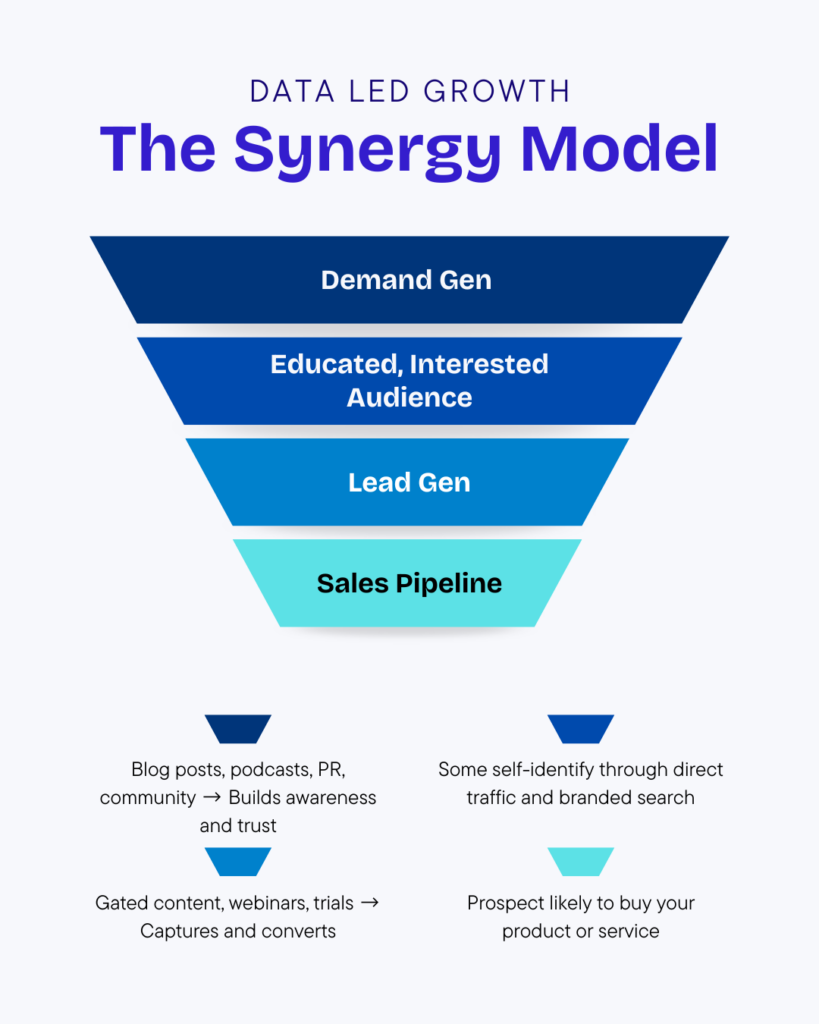
Demand gen feeds the top. Lead gen catches what falls through. Neglect demand gen, and your lead gen channels run dry. Neglect lead gen, and your demand gen efforts build brand equity you never monetize. The synergy is not optional — it is the entire point of understanding this distinction.
In the next section, we will explore specific cost-effective tactics that teams of 1–20 people can use to execute both sides of this framework without burning budget.
Cost-Effective Strategies for Teams of 1–20 People
Once you’ve assessed your stage using the framework above, the real work begins. You need tactics that deliver results without burning cash. The good news? Lean teams have a structural advantage—they move faster, make decisions in minutes, and pivot without bureaucracy.
Here are the highest-leverage strategies for lead generation and demand generation, built for teams with more ambition than budget.
Lean Lead Generation Tactics (Low Cash, High Focus)
Optimize existing traffic before buying more. Most startups pour money into ads before fixing what they already have. Run a quick audit of your website. Add clear CTAs to your high-traffic blog posts. Implement an exit-intent pop-up on key pages. A 1% conversion improvement on your current traffic costs nothing. Over a quarter, that improvement compounds into real pipeline. Our guide on Mastering Your Marketing Spend walks through exactly where to look first.
Build a referral engine. Your best customers know other people like them. According to Influitive, referred customers show a 37% higher retention rate and 16% higher lifetime value. Set up a simple program that rewards both the referrer and the new customer. A discount, a credit, or even a handwritten note works. The cost is negligible. The return is predictable.
Co-marketing partnerships. Find a non-competing company that shares your audience. Propose a co-hosted webinar, a co-authored guide, or a newsletter swap. The only cost is your time and the relationship you build. Both sides get exposure to warm, relevant prospects. For lean teams, this is one of the fastest paths to qualified leads without a media budget.
Intent-based cold outreach. Use free or low-cost LinkedIn tools to spot buying signals. Look for job changes, funding announcements, or new technology stack additions. When you see a signal, send a personalized message—not a template. Volume matters far less than relevance. Ten well-researched messages outperform a hundred generic blasts. If you’re new to this, our post on What is Lead Generation in Sales? covers the common pitfalls to avoid.

Lean Demand Generation Tactics (Low Cash, High Consistency)
One high-quality blog post per week, no exceptions. Consistency beats perfection. Target long-tail informational keywords your audience actually searches for. Data from HubSpot shows that companies publishing 16+ blog posts per month get 3.5x more traffic than those publishing 0–4. Even one post per week (4–5 posts per month) puts you ahead of most competitors who publish sporadically. Search engines reward consistency. So do readers.
Repurpose ruthlessly. Create one piece of long-form content—a webinar, a podcast episode, a founder interview—and turn it into everything else. That single recording becomes a blog post, five LinkedIn posts, a newsletter edition, and a dozen short-form video clips using tools like Descript’s Underlord AI suite. This is how a team of two produces the output of a twenty-person content department. No extra recording time. No extra budget.
Founder LinkedIn as a demand gen channel. The founder’s personal brand is your startup’s most underused asset. Posting 3–4 times per week with genuine insights can generate more awareness than a $10,000 monthly ad budget. Why? People trust people, not logos. Engagement begets reach. Reach begets demand. Share what you’re learning, not what you’re selling.
“Help, don’t sell” community engagement. Join 2–3 communities where your ideal prospects spend time. Answer questions thoroughly. Share frameworks. Be generous with knowledge. Do not link to your product unless someone explicitly asks. Build a reputation as the person who helps without expecting anything in return. Demand follows reputation, not aggressive self-promotion.

Measuring What Matters Without Expensive Tools
For lead gen: track the core conversion metrics. Use the free tiers of tools like HubSpot, or stick to a spreadsheet paired with Google Analytics. Focus on cost per lead (CPL), MQL-to-SQL conversion rate, and lead velocity rate. These three numbers tell you if your lead gen engine is healthy or leaking. If you’re seeing a high CPL but low conversion, the issue is likely targeting, not volume. Our primer on What Are the 4 Ls of Lead Generation? breaks down the full funnel metrics you need.
For demand gen: monitor leading indicators. Track organic keyword rankings through Google Search Console—it’s completely free. Watch branded search volume trends over time. Measure newsletter and email subscriber growth. Collect qualitative signals like inbound mentions, podcast invitations, and unsolicited partnership requests. These metrics predict revenue long before a sales call happens.
The “how did you hear about us?” question. Add a single-field survey to your sign-up flow or checkout page. This costs nothing to implement. Yet it reveals which demand gen channels actually drive paying customers—not just traffic. You might discover that a small Slack community sends you more buyers than your entire SEO effort. Let the data, not your assumptions, decide where to invest next week.
People Also Ask (FAQ)
Is Demand Generation the Same as Inbound Marketing?
Not exactly, though they overlap significantly. Inbound marketing is a methodology focused on attracting customers through valuable content and experiences. Demand generation is broader. It includes inbound tactics but also covers outbound brand-building activities like PR, events, and community engagement. Think of inbound marketing as a key subset within the larger demand generation toolkit.
Is SEO Lead Generation or Demand Generation?
SEO is primarily demand generation. It answers user queries, builds trust, and drives organic traffic over the long term. However, optimized landing pages within that SEO strategy can effectively convert that traffic into leads. For a deeper look, our guide on what comes after lead generation explains how top-of-funnel traffic flows into pipeline.
Can You Do Lead Generation Without Demand Generation?
Yes—but only temporarily. If you operate in a mature market, buyers already understand the problem and search for solutions actively. You can generate leads through paid search, cold outreach, and gated content without investing in demand gen. However, this is a short-term play. Without demand gen feeding the top of the funnel, your addressable pool of aware buyers shrinks. Acquisition costs rise as you compete for the same finite audience. For a practical illustration, see A Simple Example of How Lead Generation Works for a Coffee Shop.
Which Should a Seed-Stage Startup Focus on First?
Immediate cash flow needs often push seed-stage startups toward lead gen first. That is understandable. But failing to invest early in demand gen can lead to unsustainably high paid acquisition costs later. The right balance depends on your market maturity and runway. If you are unsure whether you are ready for lead gen, our article on Tell Tail Signs Your Business Needs a Lead Generation Agency can help you evaluate your readiness.
How Long Does Demand Generation Take to Show Results?
Expect 6–12 months before demand gen activities translate into attributable pipeline. Content needs time to rank in search engines. Brand trust compounds slowly. However, indirect signals often appear within 3–6 months if you publish consistently. Watch for growing organic traffic, more branded searches, and higher engagement rates. These early indicators tell you your demand engine is starting to work.
What Metrics Should a Startup Track for Demand Generation?
For early-stage startups, the most practical demand gen metrics are simple. Track organic search traffic growth using Google Search Console. Monitor branded search volume trends. Watch newsletter and email subscriber growth. Measure content engagement through time on page and scroll depth. Pay attention to qualitative signals like unsolicited referrals, podcast invitations, and inbound partnership requests. Avoid over-indexing on “attributed pipeline” in the first year. Demand gen’s contribution to revenue is real but rarely linear.
How Do AI Video Tools Fit Into Demand Generation for Startups?
AI video repurposing platforms enable lean teams to produce more content without adding headcount. Tools like Vizard, OpusClip, Munch, and Descript’s Underlord AI suite let you record one long-form piece—a webinar, founder interview, or product walkthrough—and automatically extract dozens of platform-optimized short clips. This makes video-first demand gen feasible for teams of just 1–5 people. According to Vidyard’s 2024 Video in Business Benchmark Report, businesses using video content drive 49% faster revenue growth. For more on building an efficient marketing engine, see our guide on mastering your marketing spend.

Building Your Startup’s Hybrid Growth Engine
Here is the insight that changes everything about how you think about marketing: lead generation vs. demand generation is not a binary choice. It is a dynamic ratio that shifts with your company’s stage and goals. The most successful early-stage startups constantly recalibrate this ratio based on market maturity, revenue pressure, and the compounding returns of their demand gen investments. This mindset separates companies that scale efficiently from those that quietly burn through their runway.
Here is your practical takeaway for this week — broken into three steps. First, assess your market maturity using the framework we covered earlier in this guide. Second, pick a starting ratio based on your runway — for example, 60% lead gen and 40% demand gen if you have 6–18 months of cash. Third, execute one lead gen tactic and one demand gen tactic with consistency for the next 90 days. After that window, re-evaluate your ratio and adjust. Small, consistent corrections compound into massive advantages over time.
The long-term vision is simple. Demand generation builds the forest. Lead generation harvests the trees. Neglect either one, and you either starve today or starve tomorrow. Nurture both disciplines, and you build a growth engine that becomes more efficient — and harder for competitors to replicate — every single quarter. For a deeper look at how lead gen fits into the full customer acquisition cycle, read our guide on what comes after lead generation.
Here is your next step. Audit your last 90 days of marketing activity. Ask yourself honestly: what percentage was spent capturing existing demand versus creating new demand? Then adjust one thing this week to close the gap. If you want to dig deeper into how to allocate budget between the two approaches, our piece on mastering your marketing spend offers practical benchmarks for lean teams.

What is your current lead-gen-to-demand-gen ratio? Share your experience in the comments — we would love to hear what is working for your stage and market.

Leave a Reply